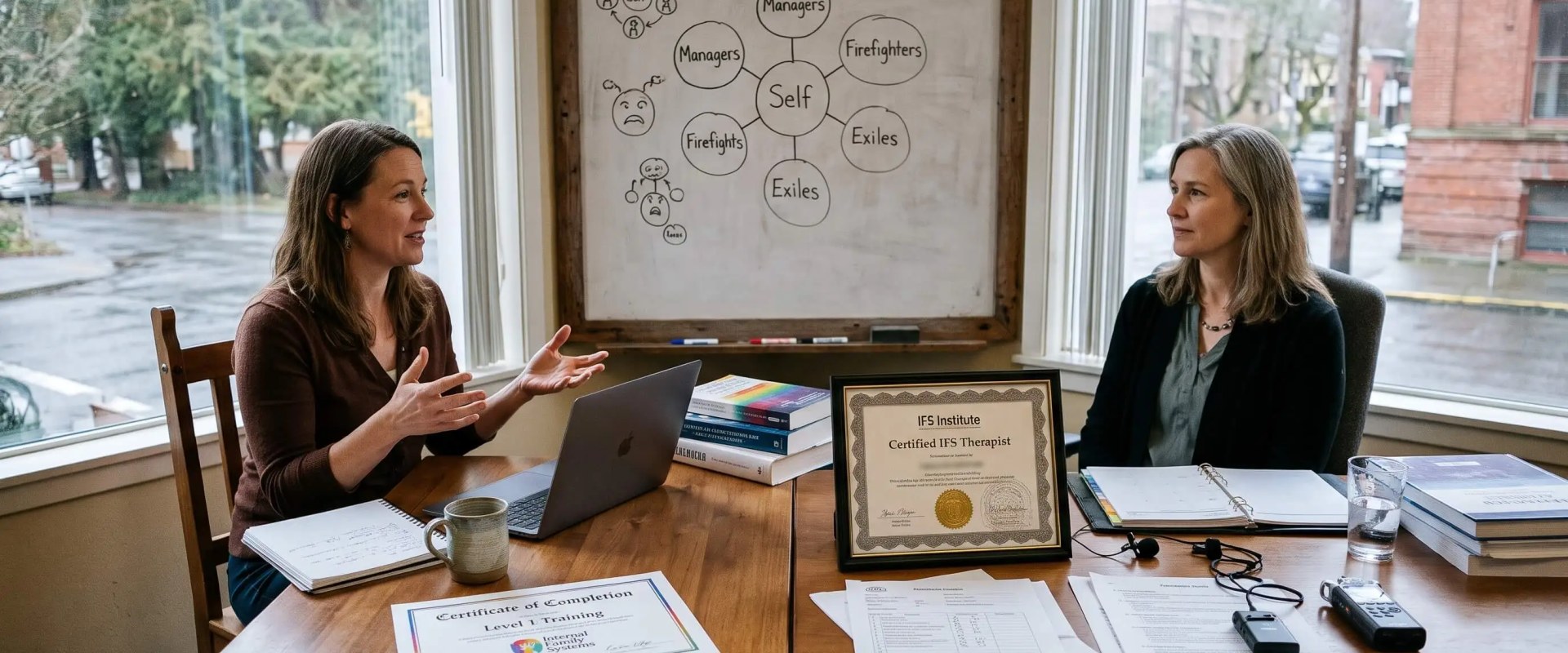
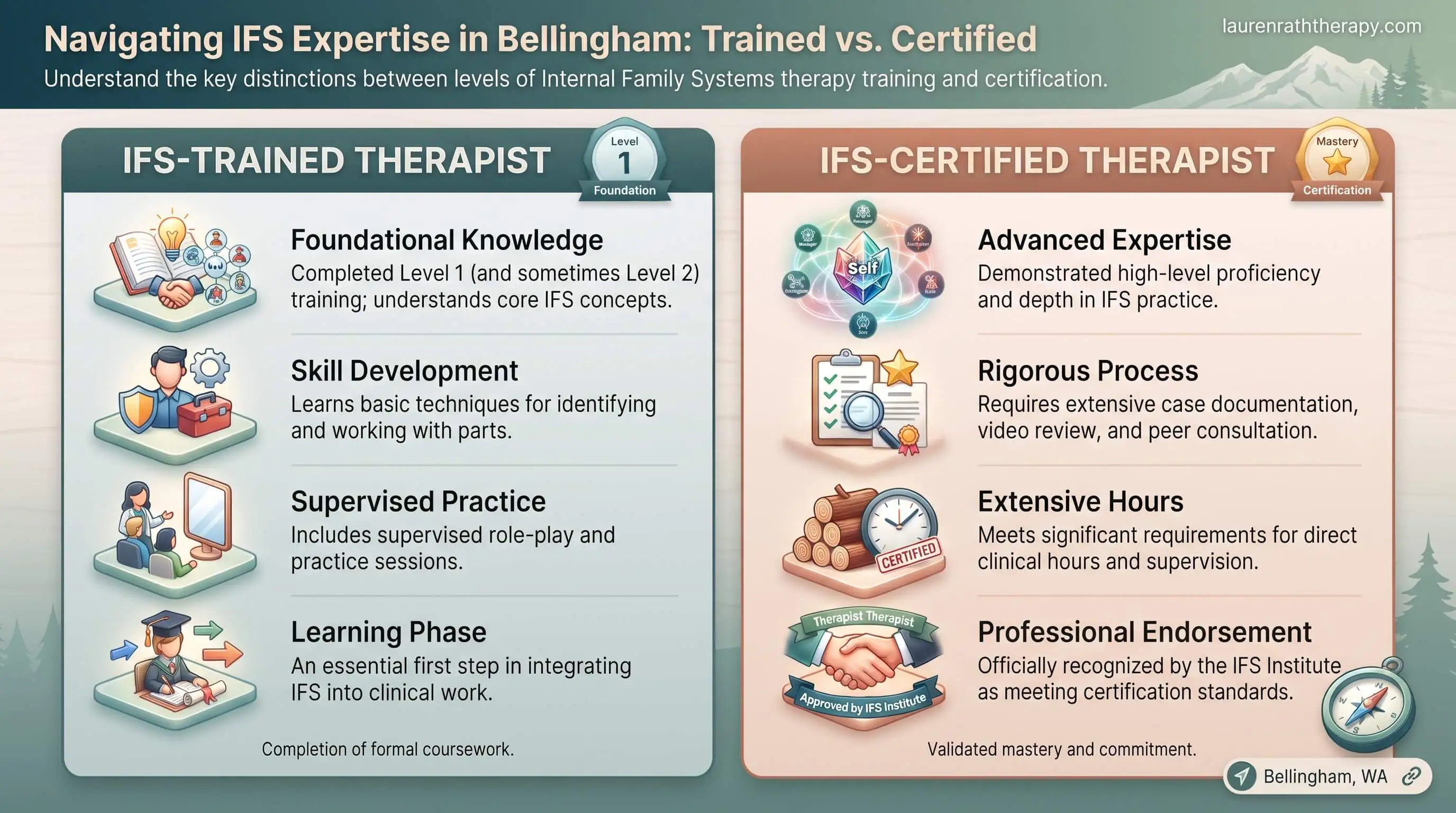
An IFS-trained therapist has completed some Internal Family Systems training, usually a Level 1 program through the IFS Institute. An IFS-certified therapist has finished Level 1 and Level 2, practiced IFS for at least two years and 200 hours after Level 1, logged 30 hours of continuing education and consultation, and submitted recorded sessions for review.
If you're searching for an IFS therapist in Bellingham, WA, that difference deserves a few minutes of your attention. Wound care readers already know the instinct. You ask whether a provider is a certified wound specialist or someone who has simply changed a lot of dressings, and nobody calls that rude. The same care belongs here, when the person you choose will sit with the more guarded parts of you.
TL;DR Quick Answers
IFS Therapist Bellingham WA
Lauren Rath, MA, LMHC, is an IFS therapist who sees Bellingham, WA adults by secure video. She trained in Internal Family Systems through the IFS Institute, and her sessions move at whatever pace your protective parts can handle.
License: Licensed Mental Health Counselor in Washington
IFS background: trained through the IFS Institute
Format: online only, for adults located anywhere in Washington
Focus: trauma and CPTSD, anxiety, attachment, perfectionism
Insurance: in-network with BCBS, Aetna, Regence, Premera and Cigna
First step: a free 15-minute consult
Before you book: check any therapist's license on the Washington DOH Provider Credential Search
No I-5 drive and no hunt for parking, just your own chair on a rainy Whatcom County evening. One sentence is enough to start.
Top Takeaways
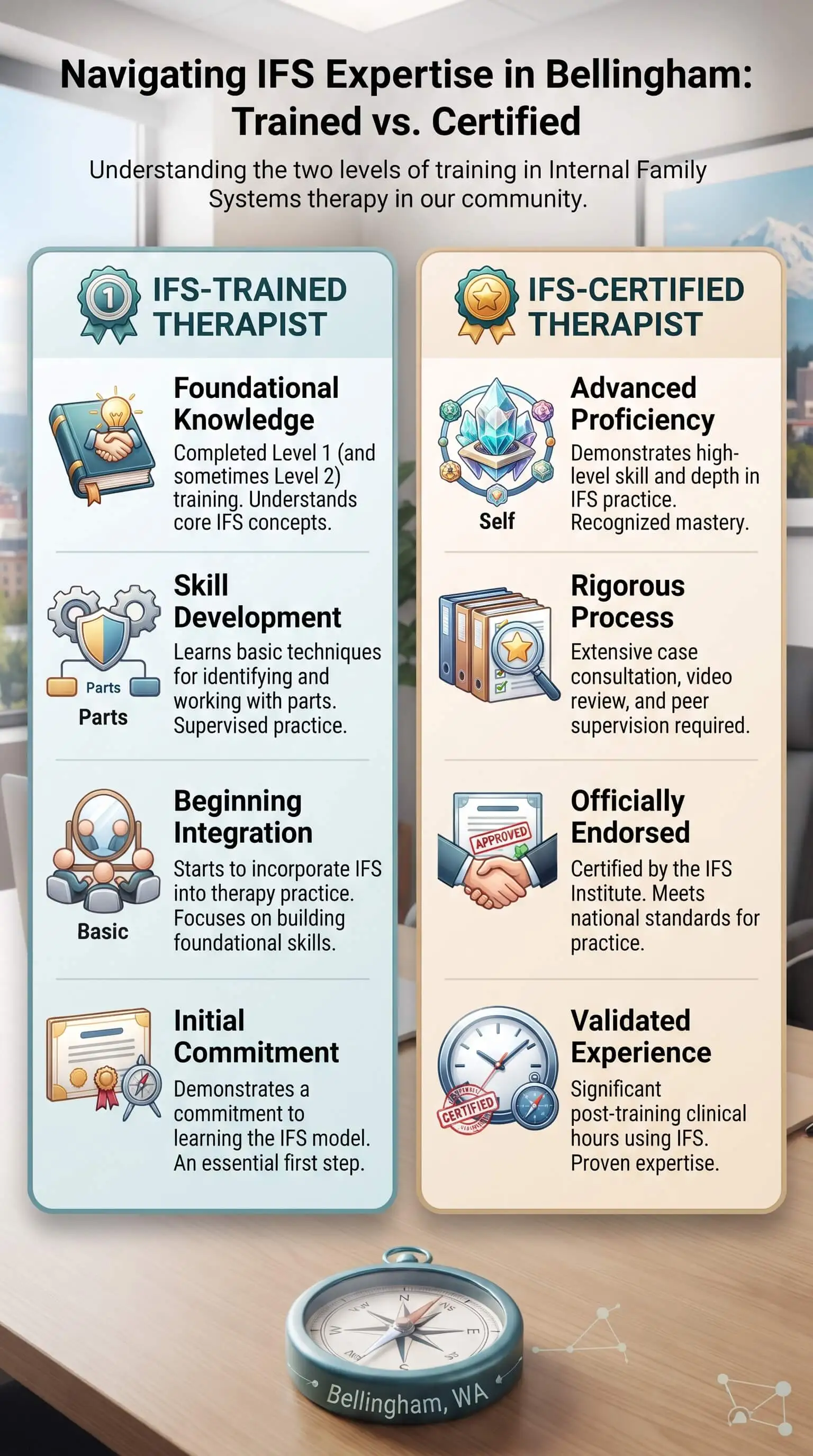
IFS-trained means someone has completed some IFS education, while IFS-certified means the IFS Institute has reviewed and approved their work.
Finishing Level 1 earns a certificate of completion, and that isn't the same as certification.
Certification takes at least two years and 200 hours of IFS practice after Level 1.
Neither label is a license, so look up any Washington therapist on the DOH Provider Credential Search.
Secure video gives people in Bellingham and Whatcom County a wider pool of IFS therapists to choose from.
What "IFS-Trained" Usually Means
The IFS Institute runs three levels of training, called Level 1, Level 2 and Level 3, and each one adds depth and practice in the model.
Level 1 is where most therapists start. It teaches how parts and the Self work together, and how to get to know protective parts without forcing your way past them. People who finish it receive a certificate of completion, which is a different thing from certification.
"Trained" also isn't a protected word. One therapist might use it after a full Level 1 cohort, and another after a weekend workshop. Both can be telling the truth. You still deserve to know which one you're reading, so ask which program and level they completed, and when.
What "IFS-Certified" Requires
Certification comes later, as its own credential. The IFS Institute awards it once a therapist shows competence in the model, and it never arrives automatically at the end of a training.
Under the IFS Institute's current certification policy, an applicant needs:
One Level 1 and one Level 2 training, or Level 1 plus a Level 1 completed as a Program Assistant
At least two years and 200 hours of regular IFS practice after Level 1, signed off by an IFS Approved Clinical Consultant
15 hours of IFS continuing education
15 hours of IFS consultation, with at least 7 of those hours one-on-one
Recorded sessions submitted for video review
Only licensed clinicians can hold the IFS Certified Therapist title. Coaches and other non-clinicians can work toward a separate credential called IFS Certified Practitioner.
The rules changed on May 1, 2023, so an older article quoting one year of practice or 20 consultation hours is working from the old policy.
IFS-Trained Vs. IFS-Certified At A Glance
IFS-Trained
Shows some completed IFS training
Path varies, often Level 1 alone
The training program issues it as a certificate of completion
Not a license
Worth asking which level, and when
IFS-Certified
Shows competence the IFS Institute has reviewed
Requires Level 1 and Level 2 or a Program Assistant role, two years and 200 hours of practice, 30 hours of education and consultation, and session review
The IFS Institute grants it through its certification process
Not a license
Worth asking whether it's Certified Therapist or Certified Practitioner
A License Comes First
Neither label gives anyone the legal right to practice. In Washington, that comes from a state credential, and for many counselors it's the Licensed Mental Health Counselor license, or LMHC. IFS training and certification sit on top of it.
You can check any Washington therapist on the Department of Health's Provider Credential Search by name or credential number. If you only run one check before booking, make it this one.
Finding An IFS Therapist In Bellingham, WA
Whatcom County doesn't have many IFS clinicians, and the ones it has tend to keep waitlists. A search can stall for weeks.
Secure video widens the field. A Washington-licensed therapist can see you anywhere in the state, so the I-5 drive and the downtown parking loop drop out of the picture, along with the rush out of work on a wet November evening.
Lauren Rath, MA, LMHC, offers online sessions for anyone who wants an IFS therapist Bellingham WA without the commute. She trained in IFS through the IFS Institute and works with adults located in Washington, mostly around trauma and CPTSD, anxiety, attachment and perfectionism. Getting started means a free 15-minute consultation.
Questions To Ask Before You Book
Which IFS training levels have you completed, and when?
Are you IFS certified, or working toward it?
Do you get ongoing IFS consultation?
What's your Washington license type and number?
Do you see clients in person, online or both?
What don't you treat, and where do you refer for it?
A good therapist won't flinch at any of these, and plenty will be glad you asked.
If You Need Support While You Search
Finding the right fit can take a few weeks, and you shouldn't have to white-knuckle that stretch on your own. The NAMI HelpLine offers free peer support, information and referrals. Call 800-950-6264 or text "helpline" to 62640, Monday through Friday from 10 a.m. to 10 p.m. ET.
The HelpLine isn't a crisis service. If you're using a burn degree chart to understand an injury and struggling with the emotional impact, remember that immediate support is available. If you're in danger or thinking about ending your life, call or text 988 now, at any hour, or dial 911. Please don't wait for an appointment.
"A training certificate tells you what someone studied. It can't tell you how they'll sit with the part of you that's been standing guard for years. In my work with adults across Washington, the first fifteen minutes on a call usually say more than anything on a profile. I'm listening for whether your protective parts feel respected or rushed. If they feel rushed, that's useful information, whatever the credential says."
Essential Resources
IFS Institute: Eligibility Requirements For IFS Certification
The official checklist behind certification, from training levels to consultation hours.
Source: IFS Institute Help Center
IFS Institute: What Is IFS Certification?
Explains why finishing Level 1 doesn't make anyone certified.
Source: IFS Institute Help Center
IFS Institute: Directory Terms Explained
Handy when a listing mentions levels, certification or consultants and you want to read it right.
Source: IFS Institute Help Center
Washington State Department Of Health: Provider Credential Search
Look up any Washington therapist's license by name or credential number.
Source: Washington State Department of Health
NAMI HelpLine
Free peer support, information and referrals while you look for care.
Source: NAMI
Psychology Today: Internal Family Systems Therapy
A plain overview of how IFS works and what a session can feel like.
Source: Psychology Today
988 Suicide & Crisis Lifeline
Call, text or chat 988 at any hour for free, confidential crisis support.
Source: 988 Lifeline
If you're looking for an IFS therapist for anxiety, these essential resources can help you understand IFS certification, verify a therapist's credentials, and find reliable mental health support. The IFS Institute, Washington State Department of Health, Psychology Today, and NAMI offer guidance to help you make informed decisions when choosing a therapist.
Supporting Statistics
23.4% of U.S. adults, roughly 61.5 million people, experienced mental illness in 2024. If you're reading this for yourself, you have a lot of company. Source: NAMI, Mental Health By The Numbers
52.1% of U.S. adults with mental illness received treatment in 2024. That leaves nearly half without care, which is part of why a clear search matters. Source: NAMI, Mental Health By The Numbers
IFS certification requires at least two years and 200 hours of IFS practice after Level 1. Those are minimums, so the credential reflects years of steady work rather than a single course. Source: IFS Institute
Mental health challenges affect millions of U.S. adults, yet nearly half of those experiencing mental illness do not receive treatment. For people coping with the emotional stress of chronic conditions such as skin ulcers, finding a qualified IFS therapist can provide support for anxiety, fear, and self-criticism. IFS certification requires extensive training and practice, making therapist credentials an important consideration when seeking care.
Final Thoughts And Opinion
I'd take certification seriously. It means a therapist kept practicing IFS for years under consultation and then let an experienced reviewer watch their actual sessions. That's a lot of accountability to sign up for.
I wouldn't treat it as the whole decision, though. A licensed therapist who finished Level 1, keeps learning and makes your guarded parts feel safe may suit you better than a certified one with a six-month waitlist. Training levels are easy to line up side by side, while feeling understood is harder to measure and usually matters more once sessions begin.
If I were looking for an IFS therapist in Bellingham, WA, I'd check the license first, ask about training second and pay close attention to how the consult call feels. And if part of you keeps putting this search off, it probably has its reasons. You can bring that part along too.
Frequently Asked Questions
Q: What Does IFS-Certified Mean?
A: It means the IFS Institute granted the therapist formal certification after a separate review. To get there, they finished Level 1 and Level 2 training or served as a Program Assistant, practiced IFS for at least two years and 200 hours after Level 1, completed 30 hours of education and consultation, and submitted recorded sessions for review.
Q: Is Level 1 IFS Training A Certification?
A: No. Level 1 ends with a certificate of completion, which shows someone finished the training. Certification is a separate credential that asks for more practice, consultation and review, so a therapist with Level 1 can honestly call themselves IFS-trained but not IFS-certified.
Q: How Long Does It Take To Become IFS Certified?
A: Two years after Level 1 at the very least, with 200 hours of IFS practice inside that window. Level 2, 30 hours of continuing education and consultation, and session review all happen alongside it. The IFS Institute treats those as minimums, so the path can easily run longer.
Q: Do I Need An IFS-Certified Therapist, Or Is IFS-Trained Enough?
A: That depends on what you need. Certification shows years of reviewed practice, and a licensed, IFS-trained therapist who stays in consultation can still be a strong fit. Check the license, ask about training, then notice how the first conversation feels. Give that feeling plenty of weight.
Q: How Do I Verify A Therapist's License In Washington?
A: Use the Washington State Department of Health's Provider Credential Search. Enter the therapist's name or credential number to see their license type and status. The search is free, and the Department of Health treats it as the primary source for verifying credentials, so it's worth a look before you book with anyone.
Q: Can I Do IFS Therapy Online In Bellingham, WA?
A: Yes. A therapist licensed in Washington can see you by secure video as long as you're in the state during sessions. For a lot of people in Bellingham, that means more IFS options and a session that fits around work instead of swallowing an afternoon.
Q: How Do I Find An IFS Therapist In Bellingham, WA?
A: Start with directories that let you filter for Internal Family Systems, and lean on the IFS Institute's directory terms to read each listing correctly. Then look further afield at Washington-licensed therapists who work by secure video. Verify the license, ask about training and book a short consultation.
Book A Free Consult
You don't need the right words yet. A sentence is plenty to start.
If you're in Bellingham, elsewhere in Whatcom County or anywhere in Washington, Lauren Rath Therapy offers a free 15-minute consultation by secure video. Free, 15 minutes, no pressure. Bring your questions about training and fit, and bring the skeptical part of you as well. It's welcome here.


